
Project Type: Independent Utility App / Open Source · Stage: APK Release / Active Development · Looking for: Users, Testers & Developer Collaboration
Overview
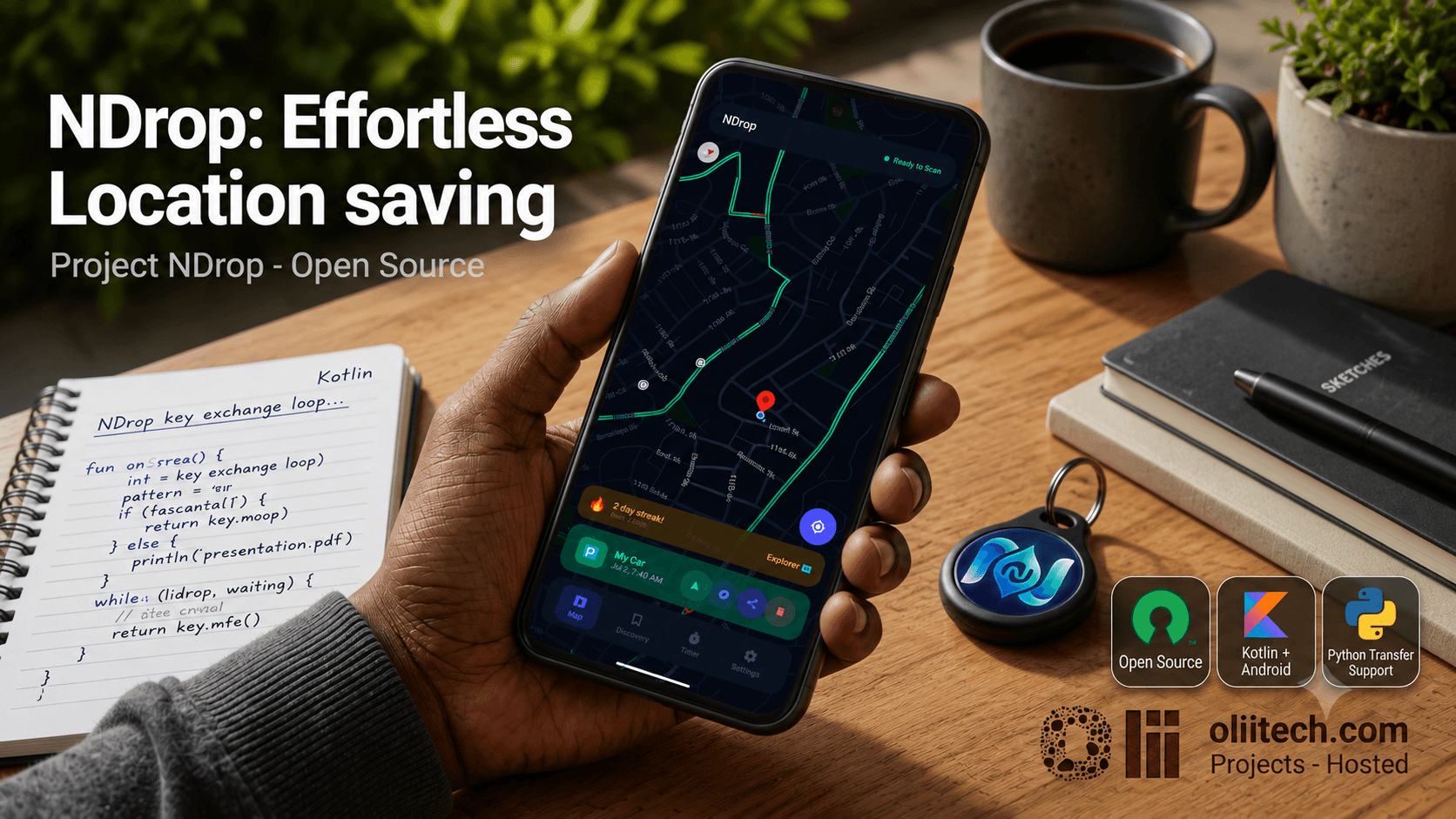
NDrop is an app built on one idea: the fastest way to save a location is to just open the app.
Tap an NFC tag on the back of your phone and NDrop drops a pin at your exact GPS location — instantly. No unlocking, no navigating menus, no typing an address. One tap, one vibration, one saved spot. It was built to solve a problem everyone has felt at least once: walking out of a mall and standing in the parking garage with absolutely no memory of where the car is.
The core project is built independently and is now open source. I'm releasing the full Kotlin codebase to the community to use, test, fork, and improve.
What I Built
Developed natively in Kotlin with Jetpack Compose, Room, and Hilt, NDrop focuses on three tag types that all do one thing each, instantly:
- Parking tag — saves your car's location and overwrites the previous spot, since you only ever have one car parked at a time
- Discovery tag — appends a new place to your personal map, for cafés, viewpoints, or anywhere worth remembering
- Timer tag — starts a countdown that keeps running even if you close the app, and notifies you the moment it's done
Beyond the core scan-to-save loop, NDrop also includes a drop streak counter, an AR-style compass that points you back to your parked car, GPX export, shareable image cards for your saved places, a home screen widget, and multi-car support for households with more than one vehicle.
Everything runs on-device. No account, no cloud sync, no ads, no tracking — your locations stay on your phone.

Current Status
- The core Android application is feature-complete and compiles cleanly
- NFC scan pipeline, location capture, and Room database are stable
- Map rendering runs on osmdroid + OpenStreetMap — completely free, no API key, no billing account required
- Background timer service and notifications are working end to end
- Currently testing on a physical Samsung device, ironing out the last UI edge cases
What I'm Looking For
I want NDrop in people's hands to see how it holds up in daily use, and I'm looking for developers who want to dig into the codebase and push it further.
💡 Users & Testers
- Download the APK, write a tag, and try the Parking → Discovery → Timer loop in your actual routine
- Tell me how scan reliability feels on your device, whether the AR compass tracks well, and what's confusing in the first 60 seconds
- Bug reports and feature requests are very welcome
💡 Developers
- The full source is open — Kotlin, Jetpack Compose, Room, Hilt, NFC foreground dispatch
- If you've worked with NFC, Compose UI, or background services on Android, there's real room to extend this: cloud sync, iOS parity, smarter tag suggestions, whatever you think NDrop is missing
- Pull requests, forks, and "I rebuilt this part better" are all fair game — this is meant to grow past what I built alone
How to Get Involved
- To use: Download the APK from the shared resources below, write your first tag, and follow the in-app onboarding
- To contribute: Clone the repository, read through the architecture, and open a pull request — or reach out first if you want to talk through an idea before building it
- To report something: Open an issue with what device you're on and what tag type triggered it
Shared Resources
- NDrop.apk — download and install
- Full source code repository
- Setup notes for writing your own NFC tags (NTag213/215/216 all work)
Don't have tags yet?
NDrop works with any NTag213, NTag215, or NTag216 chip — the small white stickers or keyrings you've seen at electronics stores. If you want to skip the search, I sell them directly through Olii Profile. Keyring format, pre-tested, ready to register in the app on first tap.
Pick up a set → oliitech.com
One tag is enough to start. Most people end up wanting three — one on the car keys for parking, one near the front door for timers, one in the bag for discoveries on the go.
Final Note
NDrop started as a small fix for a daily annoyance and grew into something I think is actually useful beyond just me. Zero friction was the whole design philosophy from day one — if using the app ever feels like work, something went wrong.
If you're someone who likes tools that disappear into your routine instead of demanding attention, give it a tap. And if you're a developer who looks at an NFC pipeline and immediately sees three ways to make it better — let's build that together.
Let me know what you think in the comments!
— Olii-8882
Rate this
Be the first to vote

Posted by
Bambo Mod KEITA
Try Everything !
"Versatile developer and designer from Bamako, Mali, with expertise in React, Python, and UI design. I'm passionate about exploring new tech, as seen in my work with NFC and Web Apps, and I always live by the motto 'Try Everything!' to tackle any new challenge."
0 Comments
Related posts
 Open Source
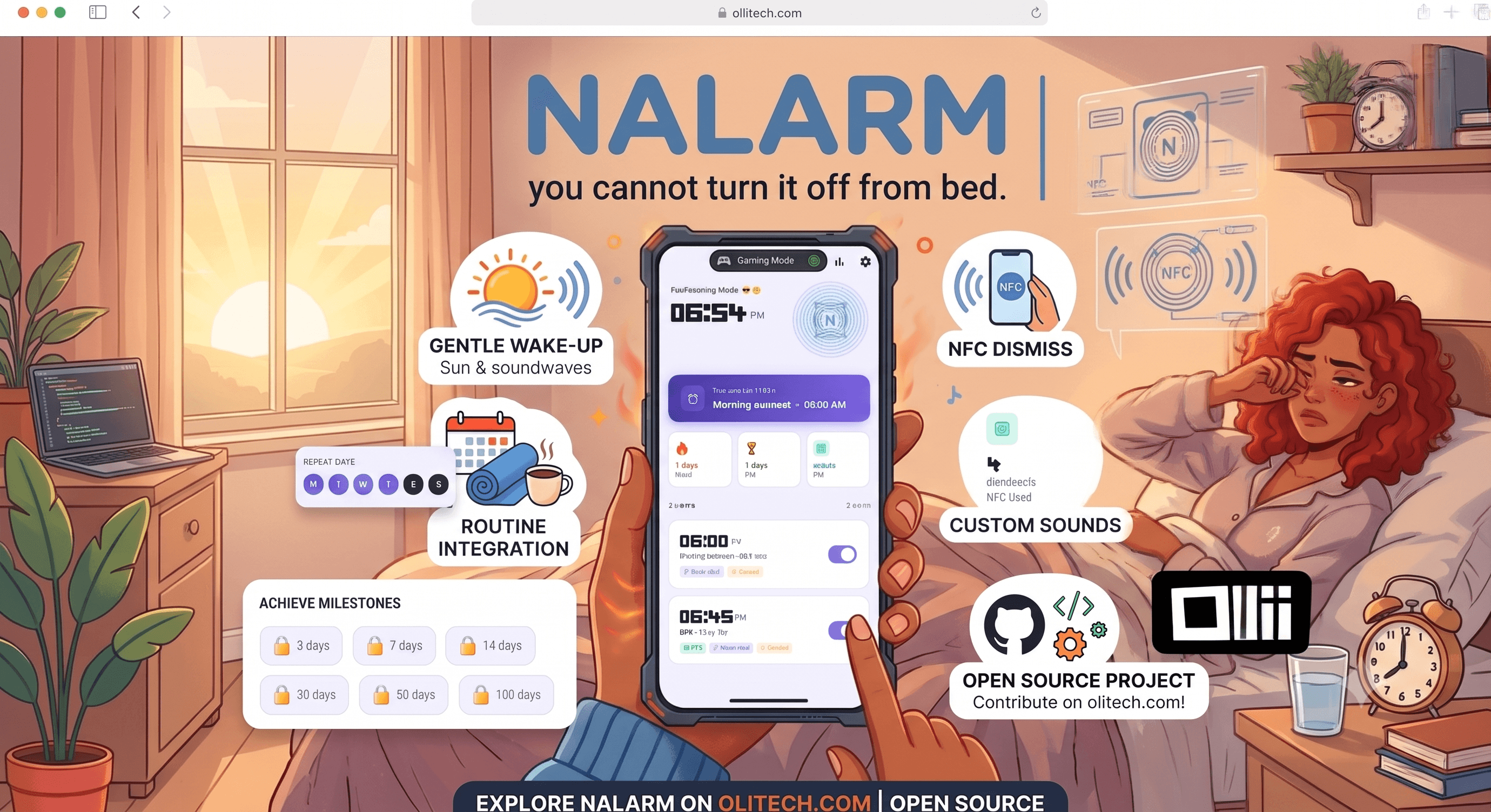
NAlarm 8882
Project Type: Open-source / Utility App / Active Development Stage: Working build — Android live, iOS in progress Looking for: Users, testers & a developer to carry it forward.
 Bambo Mod KEITA 03 months ago
 Open Source
ASTROBOT — An Intelligent Conversational AI Assistant
AstroBot Your intelligent space-themed AI assistant — university graduation project. AstroBot is a full-stack AI chat application built around an n8n workflow that routes messages through Mistral, with a layered set of features on top: image generation, OCR, retrieval-augmented generation (RAG), a
 Tidiane Konaté
 Open Source
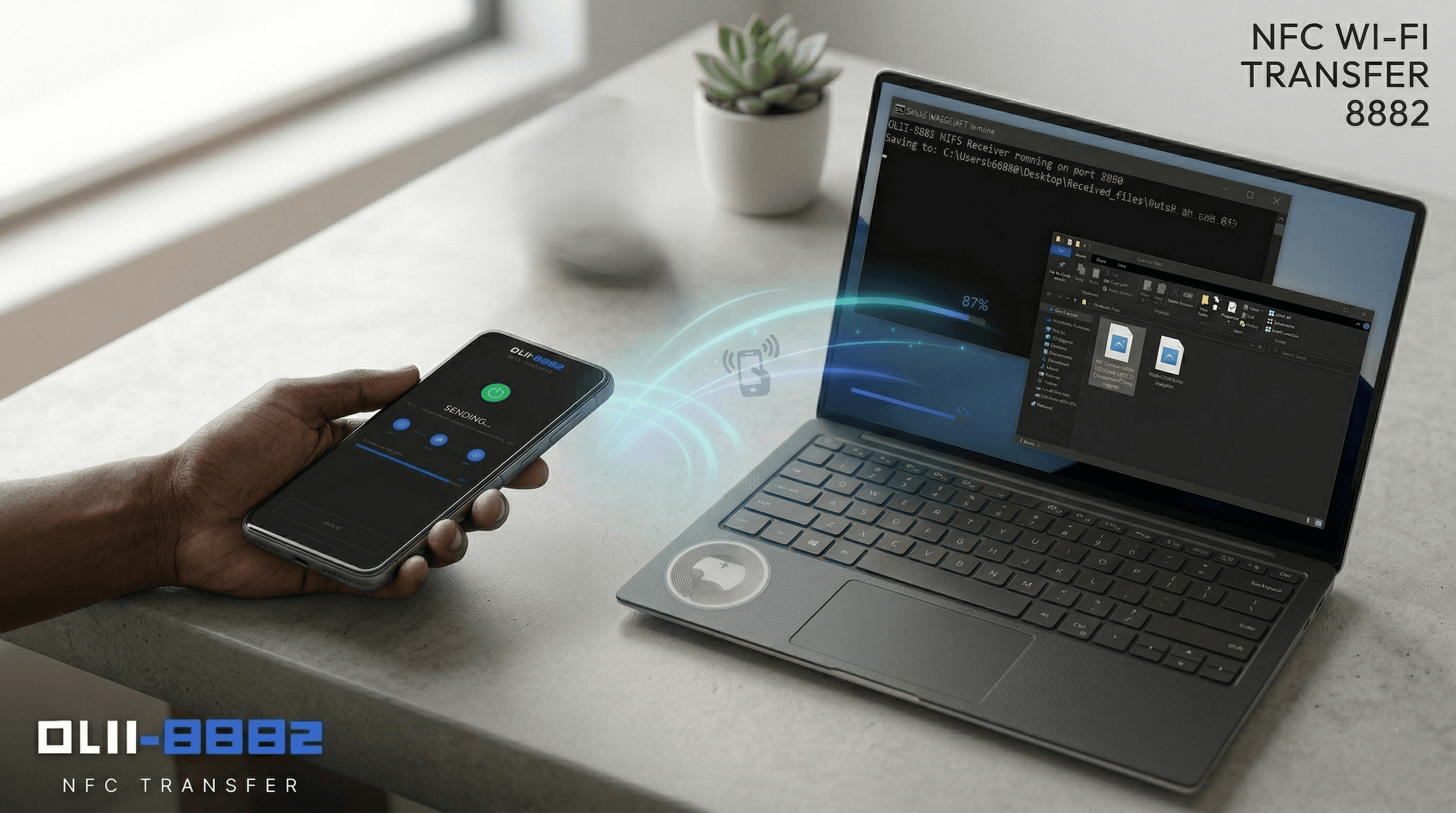
NFC Wi-Fi Transfer 8882
Tap an NFC tag, pick your files, tap again — they fly from your Android phone to your Windows PC over Wi-Fi. No cables, no pairing, no cloud, no size limits, byte-exact quality. NFC Wi-Fi Transfer 8882 solves a real daily friction point between mobile and desktop, and since v2.0 the full system is open source.
Bambo Mod KEITA