If you’ve ever tapped your phone to pay for a drink or connect to a Bluetooth speaker, you’ve used NFC (Near Field Communication). But as you explore the world of smart tags, you’ll quickly run into a specific term: NTAG.
Let’s break down exactly what an NTAG is and why it matters, in plain Human Language.
The Short Answer: What is an NTAG?
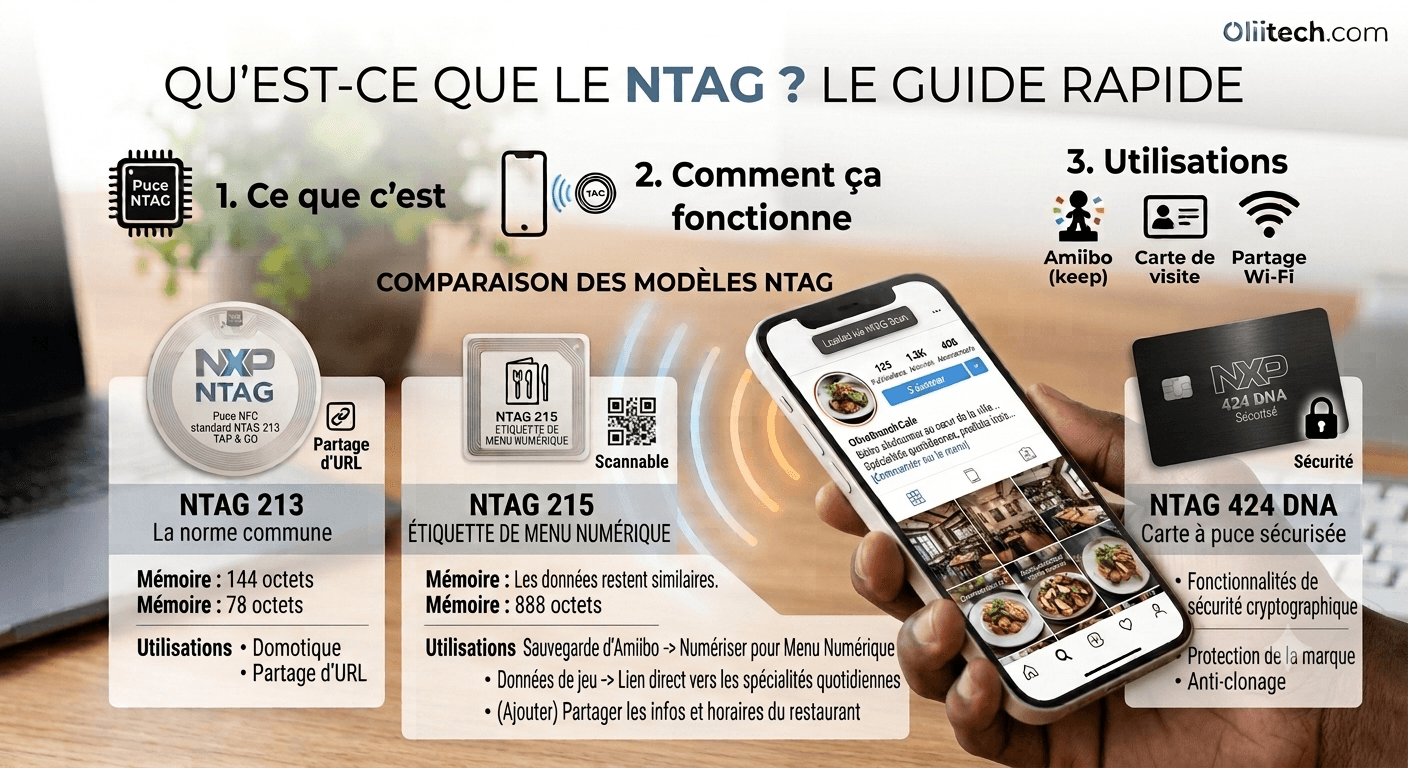
Simply put, NTAG is the industry-standard brand of NFC microchip, manufactured by NXP Semiconductors.

A standard NTAG embedded in an adhesive label. Source: Kart Plastik - ACE Kart.
Think of it like this: all NTAGs are NFC tags, but not all NFC tags are NTAGs. Just like "LIPTON" is the go-to name for Tea, NTAG is the gold standard for smart chips because they are highly secure, reliable, and work seamlessly with both Apple and Android phones. They are the tiny, invisible brains hidden inside smart stickers, digital business cards, and keyfobs.
How Do They Work? (It’s Basically Magic)
NTAGs do not have batteries. They are completely "passive."
Here is what happens when you tap:
Your phone emits a tiny, invisible magnetic field.
The antenna inside the NTAG catches that field and converts it into a split-second pulse of electricity.
This wakes up the chip, which instantly beams its stored data (like a website link or contact info) back to your phone.
Because they have no battery to drain, an NTAG can theoretically last forever!
NTAGs vs. QR Codes
Why use an NTAG instead of a free QR code?
Frictionless: With a QR code, you have to unlock your phone, open the camera, aim, and click. With an NTAG, you just tap your phone to it.
Design: QR codes are ugly and take up valuable space. NTAGs can be completely hidden inside products, under paper, or inside a plastic card.
Durability: If a QR code gets scratched or fades in the sun, it’s broken. NTAGs are safely enclosed and often waterproof.
The NTAG Family: Which one do you need?
There are three main types of NTAGs you’ll encounter:

NTAG 213 (The Standard): The most common and affordable. Perfect for smart home automation (like tapping a sticker to turn off your lights) or sharing a single website link.
NTAG 215 (The Gamer): This chip holds slightly more data, but its main claim to fame is that it’s the exact chip Nintendo uses for Amiibos. It's the go-to choice for gaming backups.
NTAG 216 (The Professional): The heavy-lifter. It has enough memory to hold full, complex vCard contact files, making it the top choice for premium digital business cards.
The Bottom Line: Whether you want to automate your living room, share your portfolio instantly, or build your own smart products, NTAGs provide the seamless "tap-and-go" magic that brings the physical world online. Get Tags from Olii!
#Guide#Tutorial
Rate this
4 / 5 · 1 vote

Posted by
Fatou KEITA
Marge
Marjorie "Marge" Bouvier Simpson.